Selected work / P♠
Projects
Tools, products, simulations, infrastructure, and evidence-gated research—with the honest limits left in.
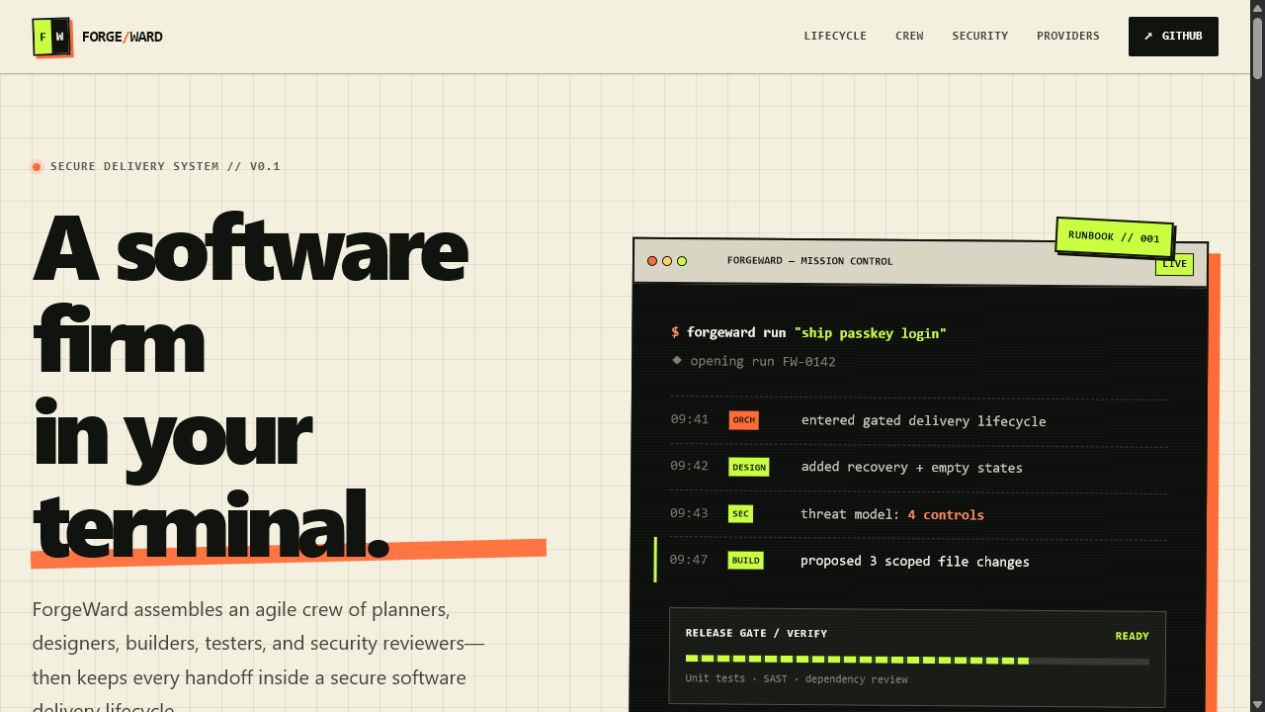
A model-agnostic, security-first software delivery harness that turns specialist model roles into a gated SDLC with human approvals and inspectable evidence.
Open projectThree public, verifier-first explorations of Conway-99, an Erdős covering problem, and the Krenn–Gu conjecture—publishing exact finite or conditional progress while keeping every global problem explicitly unresolved.
Open projectA deterministic neural-worm terrarium with contact-driven boarding, randomized Seed Forge worlds, causal control lanes, and checksummed replay—plus one unapologetically scripted aerial kickflip.
Open project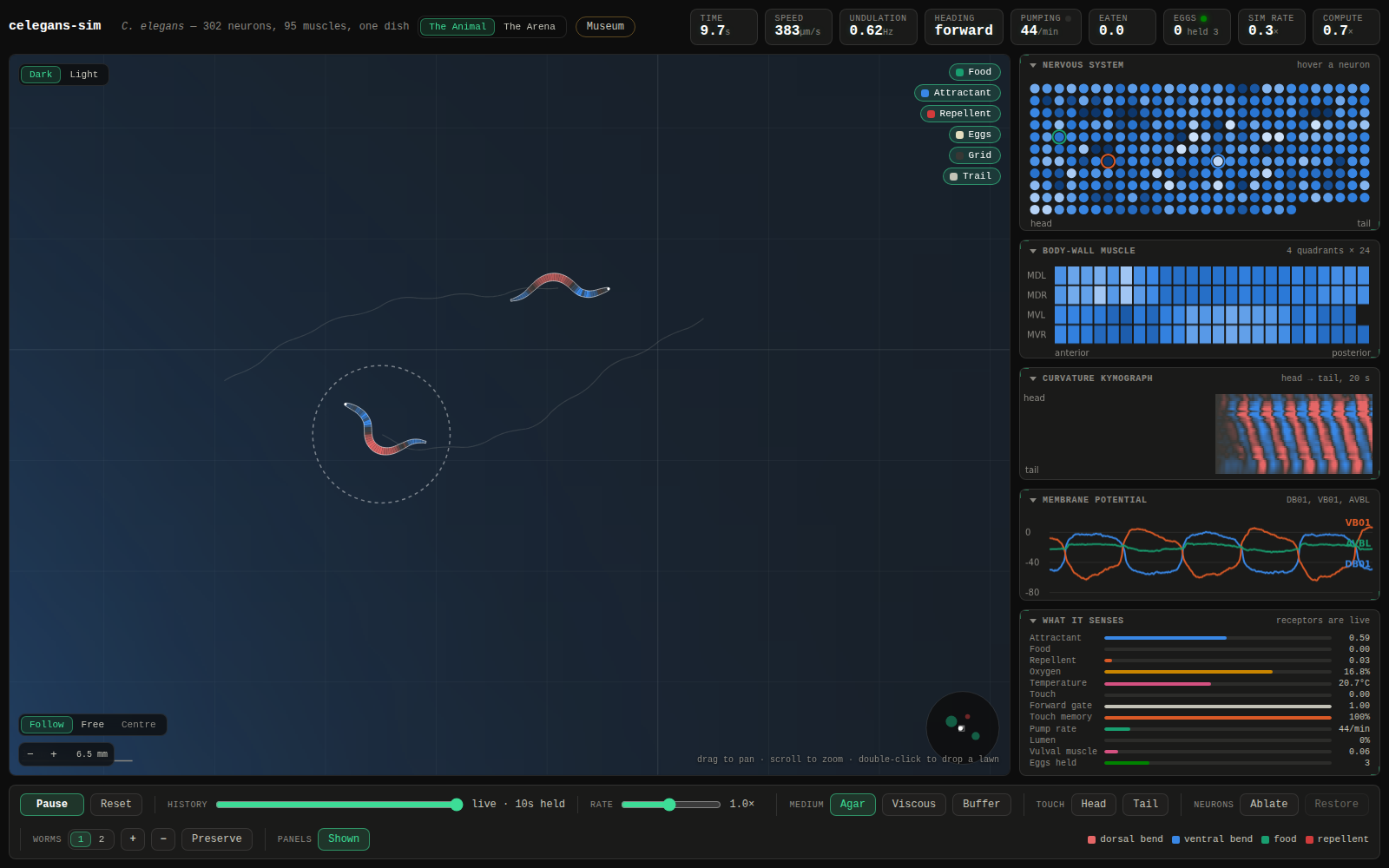
A public scientific-computing lab running 302 graded-potential neurons, 95 body-wall muscles, an inextensible low-Reynolds-number body, and a browser viewer as one closed loop.
Open projectA reproducible PufferLib training harness where one compact policy stabilizes and races 2,048 batched Crazyflie-style drones through randomized 3D rings, backed by a measured and hash-checked baseline.
Open projectA living 3D glasshouse aviary backed by a fail-safe weekly asset pipeline that quarantines, validates, optimizes, and provenance-tracks generated bird models before publication.
Open projectA private, production-shaped client value ledger that turns promised outcomes and source-backed proof into monthly briefs, client pulse signals, and transparent renewal readiness.
Open projectAn original Godot 4 vertical slice with an explorable magical hub and a complete, repeatable card duel built around readable enemy intent, mana, wards, status effects, and real win/loss states.
Open projectPrivate, local-first tooling for immutable market-data evidence, deterministic normalization, frozen offline experiments, and reports that keep plumbing checks separate from effectiveness claims.
Open project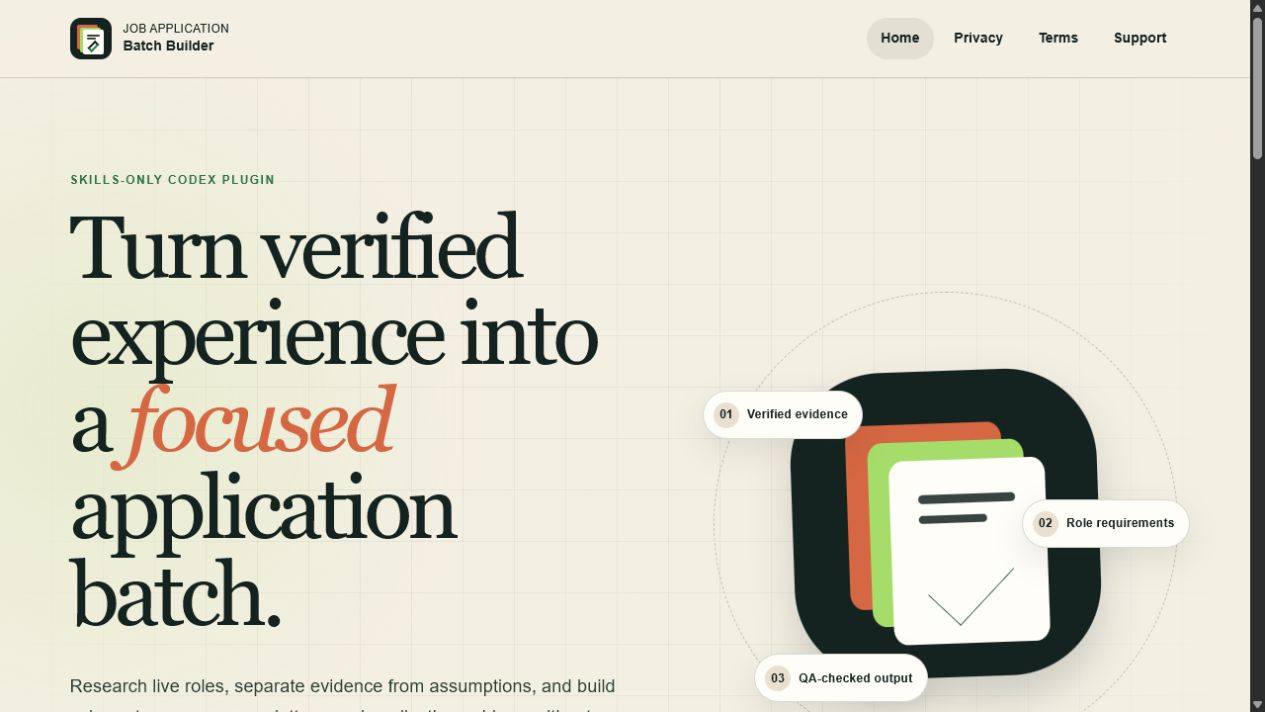
An evidence-first Codex plugin and reusable skill that researches current roles and builds truthful, role-specific application packages without quietly inventing a better candidate.
Open project
The deployment plumbing behind this site and its smaller siblings: signed webhooks, health-checked Docker rollouts, and Caddy routing on one VPS.
Open project
An interactive, repository-derived map of the Krenn–Gu proof programme that keeps scoped results, open branches, and failed routes visibly distinct while the global conjecture remains unresolved.
Open project
A small 3D aquarium for the browser, built with React and Three.js and deployed like a real app because apparently I cannot leave anything simple.
Open project
A tiny daily bird site powered by recent eBird observations, a small Express API, and an unreasonable amount of affection for birds.
Open projectA six-person capstone connecting a NestJS/PostgreSQL backend, an Expo mobile app, and a classroom reader service for verified check-ins.
Open project
Two Expo/Firebase prototypes: one for vehicle access approvals and one for QR-based classroom attendance.
Open project2026
CentraID
A six-person capstone connecting a NestJS/PostgreSQL backend, an Expo mobile app, and a classroom reader service for verified check-ins.
My notes
CentraID was the big one: six people, three codebases, physical readers, mobile apps, a backend, and a deadline that did not care how many moving pieces we had.
My strongest ownership was the backend, reader integration, deployment setup, and the documentation that kept everyone pointed in roughly the same direction. I liked the awkward boundaries most—where a phone had to talk to a reader, the reader had to survive spotty connectivity, and the backend still had to decide whether an attendance event made sense.
We finished the prototype, presented it to a three-judge panel, received an A, and left with a much better understanding of why “full stack” sometimes means “please also configure this Raspberry Pi.”
CentraID was my capstone project: a classroom attendance system built around the idea that attendance should be verified through the classroom environment, not just a direct app-to-server button.
The system combined three main pieces:
- a NestJS and PostgreSQL backend for identity, courses, schedules, reader devices, session control, attendance records, and review workflows
- an Expo and React Native mobile app for student and instructor flows, including login, device binding, schedules, attendance history, event sessions, and reader-mediated check-in
- a Python reader service designed for Raspberry Pi-style deployment, with local health/check-in endpoints, backend heartbeats, RFID input support, SQLite dedupe, and Dockerized demo scripts
My strongest ownership was on the backend, reader integration, and delivery side of the project. I worked on the API shape, TypeORM entities, attendance validation, reader heartbeat flow, Docker setup, CI quality gate, demo runbooks, and the documentation that helped a six-person team keep moving in the same direction.
The interesting engineering problem was balancing a mobile-friendly experience with stronger classroom-presence semantics. Instead of letting a student app write attendance directly to the backend, the mobile flow goes through the reader. The reader receives the active session state from the backend, exposes a local check-in path, applies throttling and dedupe, and forwards attendance events for final validation.
That made the project a good bridge between application development and systems work: API design, auth, scheduling, hardware-adjacent RFID handling, local/offline state, containerized deployment, and team process all had to fit together for the prototype to work.