Selected work / P♠
Projects
Tools, products, simulations, infrastructure, and evidence-gated research—with the honest limits left in.
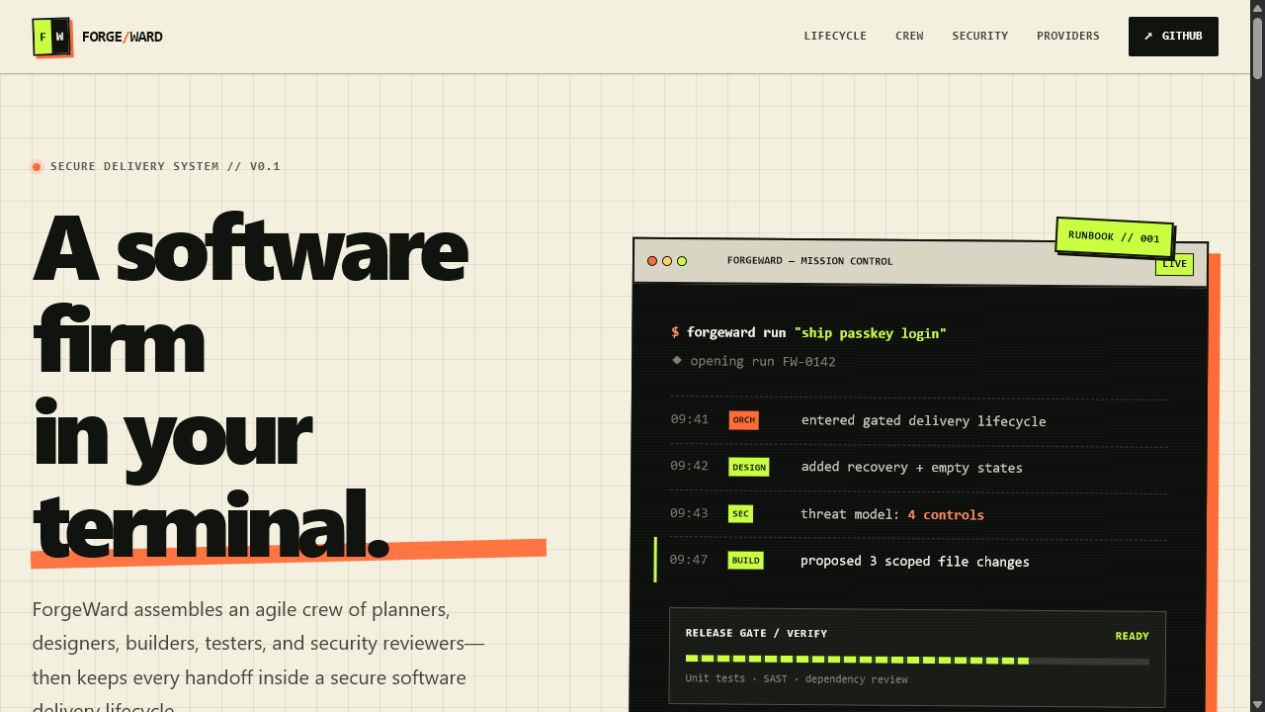
A model-agnostic, security-first software delivery harness that turns specialist model roles into a gated SDLC with human approvals and inspectable evidence.
Open projectThree public, verifier-first explorations of Conway-99, an Erdős covering problem, and the Krenn–Gu conjecture—publishing exact finite or conditional progress while keeping every global problem explicitly unresolved.
Open projectA deterministic neural-worm terrarium with contact-driven boarding, randomized Seed Forge worlds, causal control lanes, and checksummed replay—plus one unapologetically scripted aerial kickflip.
Open project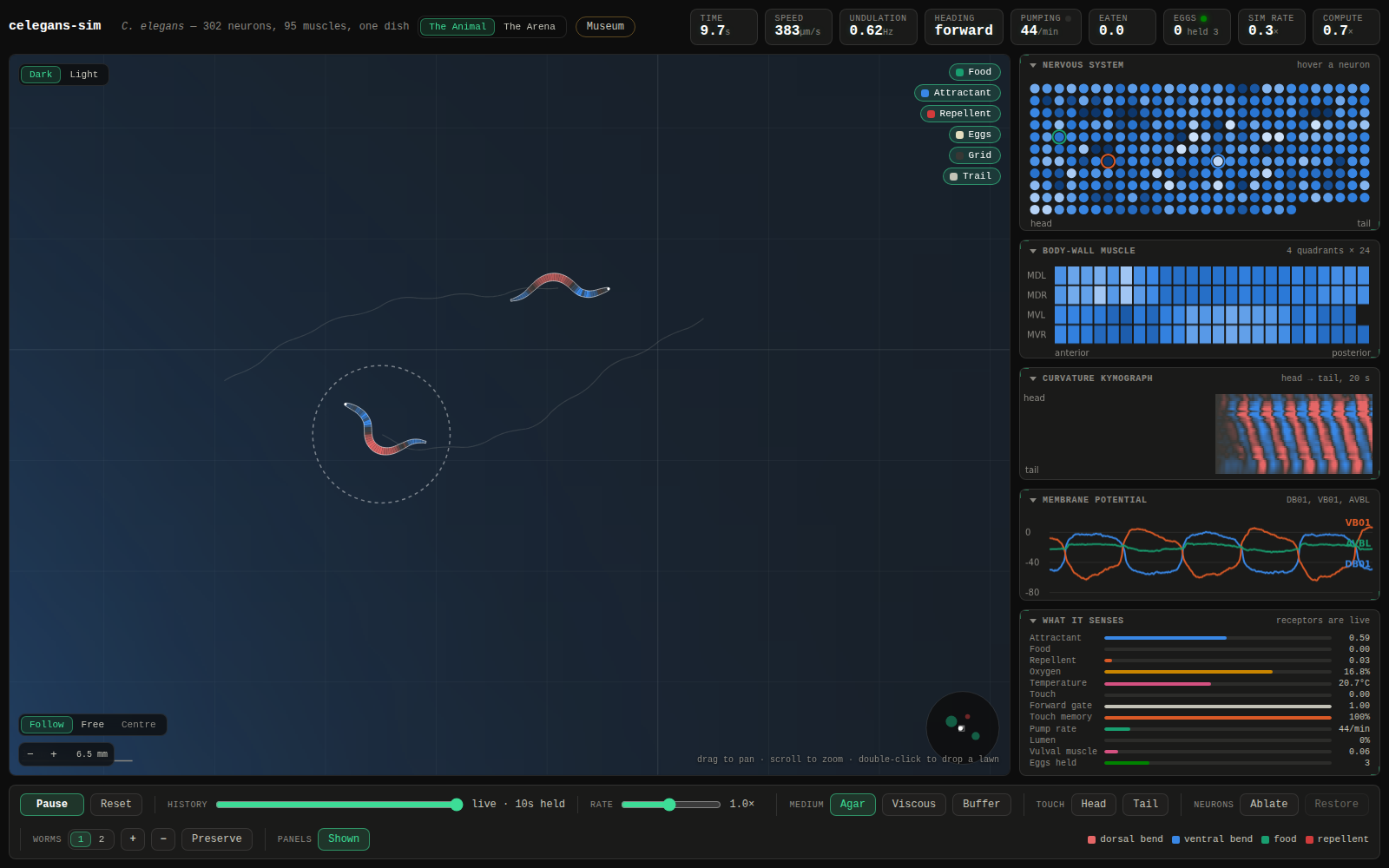
A public scientific-computing lab running 302 graded-potential neurons, 95 body-wall muscles, an inextensible low-Reynolds-number body, and a browser viewer as one closed loop.
Open projectA reproducible PufferLib training harness where one compact policy stabilizes and races 2,048 batched Crazyflie-style drones through randomized 3D rings, backed by a measured and hash-checked baseline.
Open projectA living 3D glasshouse aviary backed by a fail-safe weekly asset pipeline that quarantines, validates, optimizes, and provenance-tracks generated bird models before publication.
Open projectA private, production-shaped client value ledger that turns promised outcomes and source-backed proof into monthly briefs, client pulse signals, and transparent renewal readiness.
Open projectAn original Godot 4 vertical slice with an explorable magical hub and a complete, repeatable card duel built around readable enemy intent, mana, wards, status effects, and real win/loss states.
Open projectPrivate, local-first tooling for immutable market-data evidence, deterministic normalization, frozen offline experiments, and reports that keep plumbing checks separate from effectiveness claims.
Open project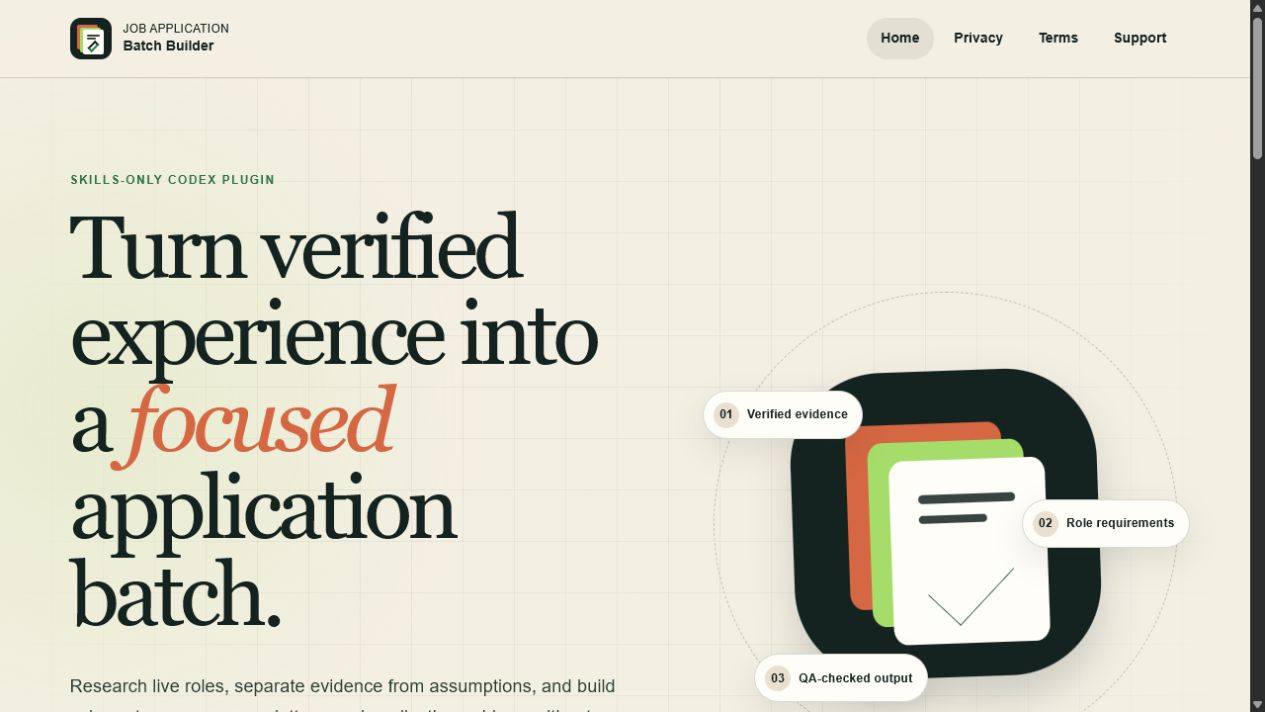
An evidence-first Codex plugin and reusable skill that researches current roles and builds truthful, role-specific application packages without quietly inventing a better candidate.
Open project
The deployment plumbing behind this site and its smaller siblings: signed webhooks, health-checked Docker rollouts, and Caddy routing on one VPS.
Open project
An interactive, repository-derived map of the Krenn–Gu proof programme that keeps scoped results, open branches, and failed routes visibly distinct while the global conjecture remains unresolved.
Open project
A small 3D aquarium for the browser, built with React and Three.js and deployed like a real app because apparently I cannot leave anything simple.
Open project
A tiny daily bird site powered by recent eBird observations, a small Express API, and an unreasonable amount of affection for birds.
Open project
A six-person capstone connecting a NestJS/PostgreSQL backend, an Expo mobile app, and a classroom reader service for verified check-ins.
Open project
Two Expo/Firebase prototypes: one for vehicle access approvals and one for QR-based classroom attendance.
Open project2026
Wurmkickflip
A deterministic neural-worm terrarium with contact-driven boarding, randomized Seed Forge worlds, causal control lanes, and checksummed replay—plus one unapologetically scripted aerial kickflip.
My notes
This started with a very reasonable question: could I teach a simulated worm to do a kickflip? It has since become a browser-native terrarium where a 16-segment worm has finite food and water, an evolved recurrent crawl controller, a skateboard, and a small laboratory for asking whether the controller is actually responsible for what visitors see.
The honesty boundary is part of the project. Crawling, seeking, and boarding are neural and contact-driven. Eating poses, dismounting, board routing, and the aerial stunt are authored. The result is more interesting than pretending the entire routine was learned: the browser can compare the live controller against zero-command and frozen-controller lanes, replay the same randomized worlds, and show exactly where control changes hands.
Wurmkickflip is a React and Three.js simulation built around a deterministic 60 Hz terrarium runtime. A tracked 16-neuron recurrent policy emits dorsal and ventral commands for a free articulated chain, whose motion emerges from internal forces, constraints, terrain friction, and contact.
Seed Forge varies 14 world, terrain, actuator, noise, spawn, and skateboard channels from a reproducible seed. Forge Trials evaluates held-out worlds across neural, zero-command, and frozen-controller lanes and preserves checksummed heat replays for inspection. The live exhibit and headless evaluation share the same episode engine.
These are finite compact-plant evaluations, not evidence of a learned kickflip, biological realism, or transfer to a real soft body. The scripted aerial boundary is visible in the UI and documentation.